

Silica Gel
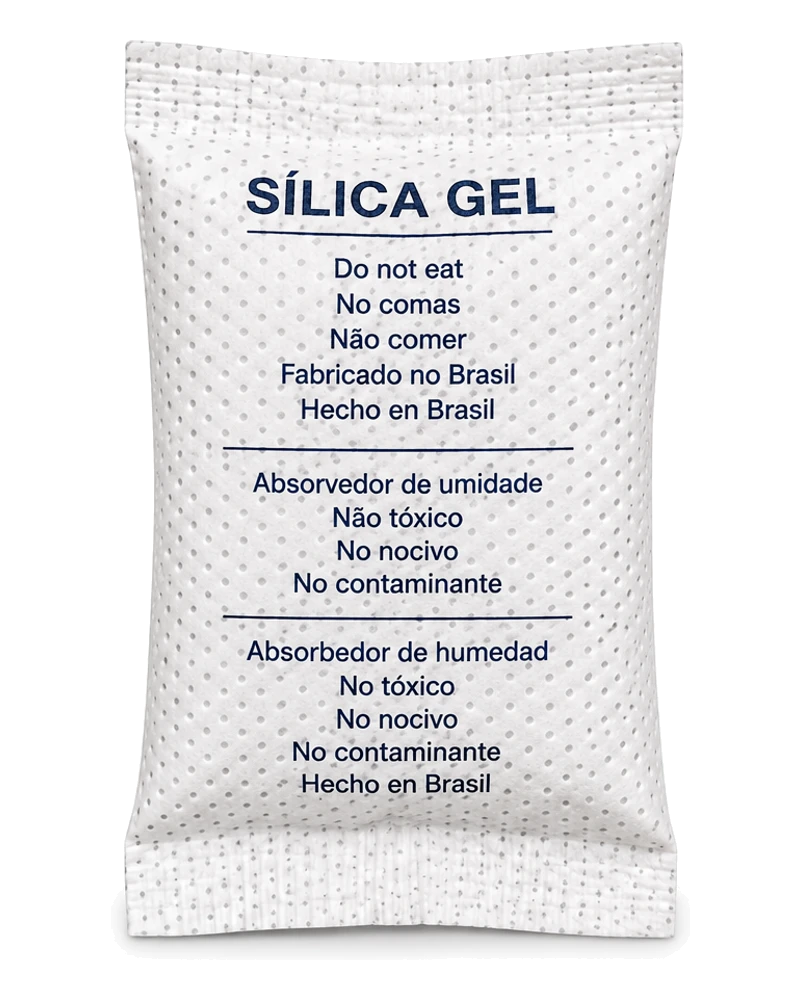
Silica gel sachets from 0.5 gram, to protect what travels inside the packaging: medicine bottles, blisters, electronic devices, optics and precision instruments.
Silica gel adsorbs moisture and holds it inside the pores of the bead itself — without changing shape, without liquefying and without transferring anything to the packaged product.
How it works
Physical adsorption: moisture is trapped in the pores
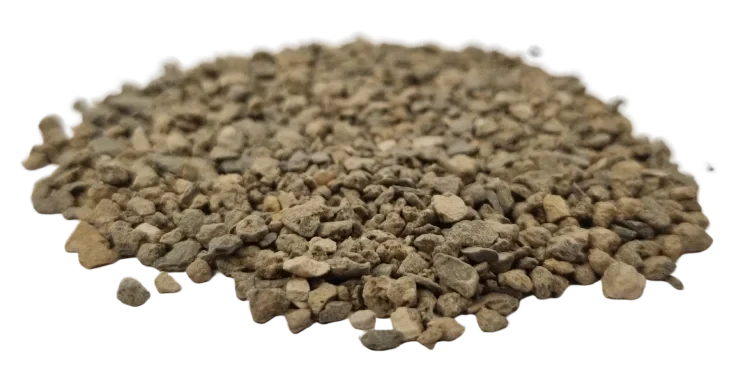
Silica gel is silicon dioxide (SiO₂) in the form of porous beads. Airborne moisture is held by physical adsorption on the vast internal surface of those pores — the bead keeps its shape and stays dry to the touch throughout its service life.
This differs from deliquescent desiccants such as the calcium chloride in Dry Box, which dissolve in the water they absorb and form a solution. Silica gel never produces liquid — which is why it is the standard choice for use inside the packaging, next to the product.
It is non-toxic, odorless, chemically inert and non-corrosive, allowing direct contact with bottles, blisters, metal components and sensitive surfaces.
Material
Silica gel characteristics
| Composition | Silicon dioxide (SiO₂) — synthetic silica gel |
|---|---|
| Physical form | Porous beads or granules |
| Mechanism | Physical adsorption — non-deliquescent, forms no solution |
| General characteristics | Non-toxic, odorless, chemically inert and non-corrosive |
| Behaviour in use | Keeps its shape and stays dry to the touch, even when saturated |
| Product contact | Suitable for use inside the packaging |
Full batch, granulometry and adsorption capacity specifications are provided in the product data sheet — request it through our contact channels.
Supply
Available configurations
| Weights | From 0.5 g — sized according to the package volume |
|---|---|
| Wrapper | Nonwoven (TNT), DuPont Tyvek® and special packaging for the pharmaceutical industry |
| Printing | Sachet marking according to customer requirements |
| Sales packaging | Defined according to volume and the customer filling line |
GRF manufactures in Brazil and adapts weight, wrapper and packaging to your production line. Talk to our technical team for the exact configuration.
Pharmaceutical industry
Why silica gel is the standard in medicines
Forms no liquid
Adsorption is physical: the bead neither dissolves nor generates solution inside the bottle.
Chemically inert
Does not react with the active ingredient or with the primary packaging material.
Sachets from 0.5 g
Sized for bottles, jars, blisters and unit packaging.
Non-toxic, no transfer
Non-toxic material: does not stain, shed dust onto the product or alter colour or odour.
Packed in a clean area
Clean, segregated area with quality control at every step of production.
Made in Brazil
Manufactured locally, with short lead times and no import costs.
Quality
Packed in a clean area, for those who cannot get it wrong
GRF silica gel is packed in a clean, segregated area, with quality control at every step — from bead intake to sachet sealing. It is the standard demanded by those who package medicine, and the same one applied to every batch.
That is why the line serves pharmaceutical laboratories, as well as diagnostics, electronics and high-value products. For those applications we also supply special packaging, developed together with the customer.
The wrapper is chosen according to the application: nonwoven (TNT) for general use, Tyvek® where higher strength and a particle barrier are required, and special packaging for the pharmaceutical industry.
The Tyvek® we use is genuine DuPont material. It is the same substrate used in medical device packaging, and it is what delivers vapour permeability with a particle barrier, plus the tear strength the pharmaceutical line demands.
Where to use
Typical applications
Silica gel protects any moisture-sensitive product inside the packaging. Most common applications:
- Medicine bottles and jars
- Supplement and nutraceutical packaging
- Diagnostics and medical devices
- Electronic components and boards
- Optical and precision instruments
- Cosmetics and personal care products
- Dried and dehydrated foods
- Tools and metal parts
- Leather, footwear and textiles
- Documents, film and archival items
FAQ
Frequently asked questions about silica gel
What is the difference between silica gel and calcium chloride desiccant?
Silica gel works by physical adsorption: it holds moisture in its pores and keeps its shape, producing no liquid. Calcium chloride (Dry Box) works by deliquescence: it absorbs far more water but dissolves in it. That is why silica gel goes inside the packaging, next to the product, and calcium chloride goes on the container walls.
What is the smallest sachet available?
From 0.5 gram. The ideal weight depends on the package air volume, the barrier of the material and the intended shelf life — our technical team helps with sizing.
Can silica gel touch the product?
Yes. The material is non-toxic, odorless, chemically inert and non-corrosive, and stays dry even when saturated — which is why it is the standard choice for use inside bottles and packaging.
Can the sachet be customised?
Yes. Weight, printing and packaging format are adapted to your filling line, and the wrapper can be nonwoven (TNT), genuine DuPont Tyvek® or special packaging for the pharmaceutical industry. Talk to our team for the exact configuration.